
As medical costs rise and the cost of living increases, more Malaysians are thinking about financial security. They seek both protection and investment. Insurance has become increasingly crucial, especially since medical inflation in Malaysia is estimated to increase around 10-15% annually. Even Bank Negara Malaysia highlights the growing awareness of financial planning and protection gaps.
Consequently, many people are asking themselves, “Should I simply buy insurance, or should I consider an investment that also provides protection for my money?” So, it is a matter of choosing between term insurance and investment-linked insurance (ILP). Read on to learn about their key differences, advantages, disadvantages, and which option may be better suited to your goals.
 If you’re a young adult in your 20s or 30s with a lower income and a tight budget, term insurance makes the most sense.
However, if you’re a parent with children and need high coverage, a term policy or a mix of term plus investments may be appropriate.
For high-income earners who want flexibility and estate planning, an ILP may be more suitable.
If you’re a young adult in your 20s or 30s with a lower income and a tight budget, term insurance makes the most sense.
However, if you’re a parent with children and need high coverage, a term policy or a mix of term plus investments may be appropriate.
For high-income earners who want flexibility and estate planning, an ILP may be more suitable.
 Insurance can be confusing due to the numerous plans available and the hidden charges from different companies. That’s why an advisor plays a crucial role in comparing options, avoiding overpayment, and aligning your financial goals effectively. At CSK Advisory, we provide tailored financial planning, compare multiple insurers, and offer the long-term support you need.
What Is Term Insurance?
In short, term insurance is like temporary protection. You may pay a small monthly premium, and if something happens to you, your family receives a payout. However, if nothing happens during the policy term, you don’t receive any money back. You may pay less for a policy that has no savings component over a fixed duration (e.g., 25 years). However, after this period ends, you can’t withdraw any money from it. Despite this limitation, many people choose such policies because they offer high coverage at an affordable cost, making them suitable for protecting family income. On the downside, if no claims are made, there’s no return on investment. Unfortunately, these policies could become more expensive if you need to renew them later.What Is Investment-Linked Insurance (ILP)?
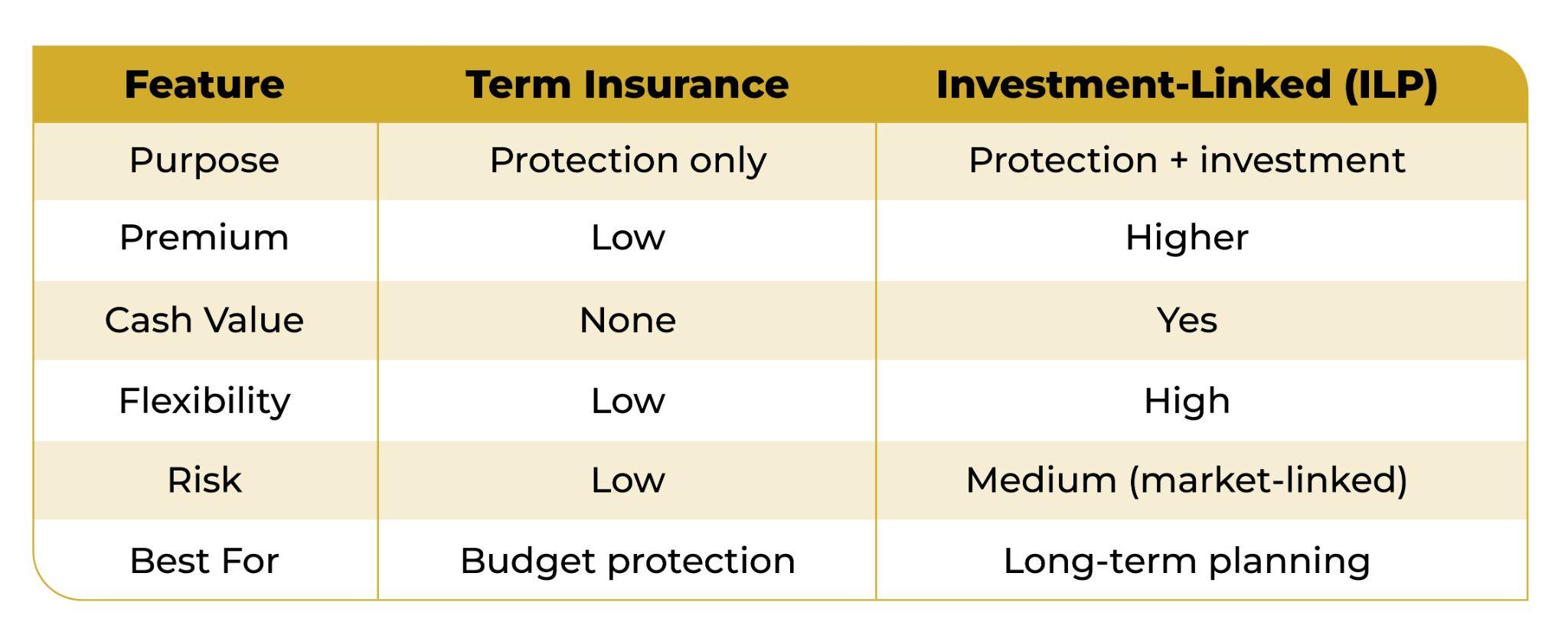
On the other hand, Investment-Linked Insurance combines insurance with an investment fund. A portion of your payment covers insurance, while the remainder is allocated to investments, such as unit trust funds. The advantage of choosing this over term insurance is that it allows you to build cash value over time. Some policies offer features such as making additional contributions (top-ups) and withdrawing some funds. However, keep in mind that your returns depend on the market. People prefer it because they feel their money is well spent, benefiting from the flexibility to adjust coverage and savings. Despite all the perks, it is generally more expensive, returns are not guaranteed, and if the investment performs poorly, the policy may lapse.Key Differences: Term vs ILP (Comparison Table)
Which Is Better in Malaysia?
There is NO one-size-fits-all answer. It depends on what you need. Choose Term Insurance if you want maximum coverage at a low cost, have dependents, prefer simple financial planning, and plan to invest separately (e.g., in unit trusts or ETFs). For example, if you earn RM4,000 per month and want RM500,000 in coverage, term insurance is the most cost-effective choice. Choose an ILP if you want bundled protection and investment, prefer flexibility, are comfortable with market risks, and aim for long-term wealth accumulation. For example, if you prefer not to manage investments separately, an ILP combines both protection and investment in a single plan.Real-Life Scenarios
If you’re a young adult in your 20s or 30s with a lower income and a tight budget, term insurance makes the most sense.
However, if you’re a parent with children and need high coverage, a term policy or a mix of term plus investments may be appropriate.
For high-income earners who want flexibility and estate planning, an ILP may be more suitable.
Common Misconceptions in Malaysia
- ILP is always better
- Not true — it depends on your needs and risk tolerance.
- Term insurance is wasting money
- Not true — you are paying for protection, similar to fire insurance.
- Insurance = investment
- Wrong mindset: insurance protects, while investments grow wealth.
Cost Comparison Example
For term insurance, RM500,000 coverage typically costs around RM50–RM100 per month. For the same coverage with an ILP, the cost is usually around RM150–RM300 per month. Why the difference? An ILP includes an investment component and higher charges. A higher premium does not necessarily mean a better plan. It simply means you are paying for additional components.How to Choose the Right Plan
Ask yourself the following questions before choosing a plan, considering your budget, financial goals, risk tolerance, and coverage needs:- Can I afford it over the long term?
- Do I need only protection, or also investment?
- Am I comfortable with market risks? Am I already investing elsewhere?
Why Work with CSK Advisory
Insurance can be confusing due to the numerous plans available and the hidden charges from different companies. That’s why an advisor plays a crucial role in comparing options, avoiding overpayment, and aligning your financial goals effectively. At CSK Advisory, we provide tailored financial planning, compare multiple insurers, and offer the long-term support you need.